Learn / Low Carb
Low CarbAre There Noodles With No Carbs?
 Jonathan Carp, MD·October 2026·~7 min read
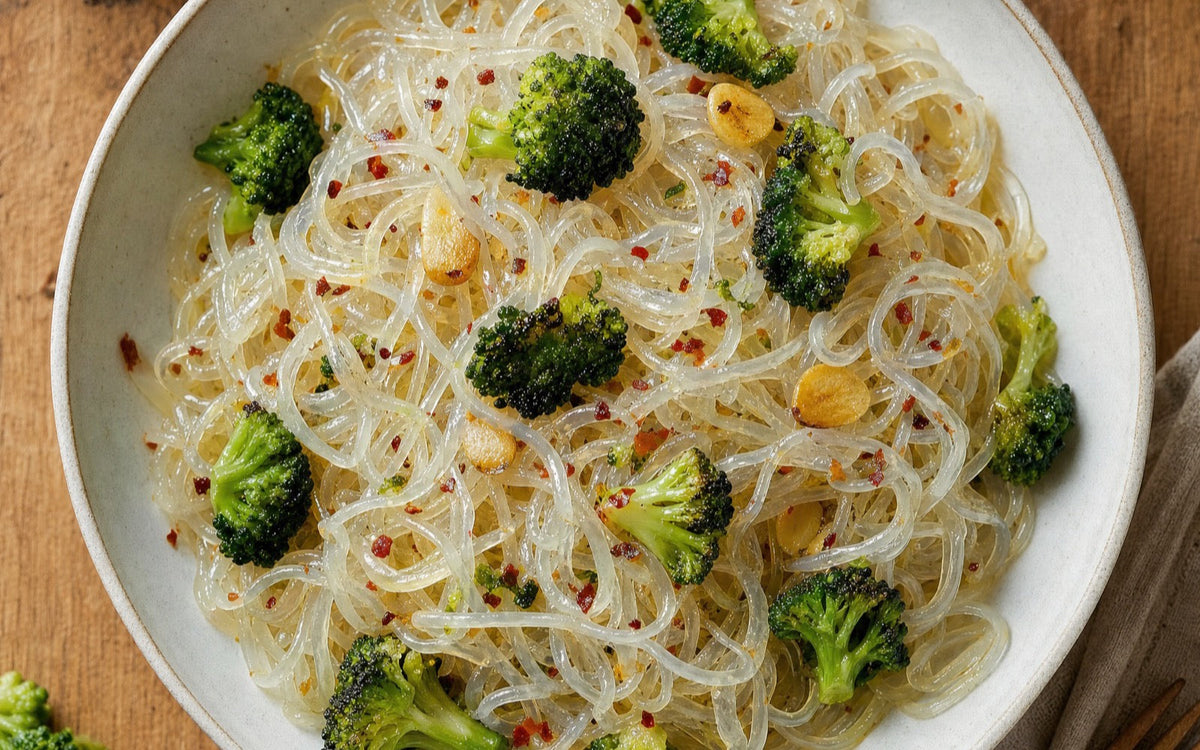
If you eat low carb or keto, noodles feel like the first thing to go. They don't have to be. Two kinds come very close to zero, and they get there in completely different ways.
No noodle is completely carb-free, but two come very close. Konjac (shirataki) noodles have 1 gram of net carbs per serving because they're made of fiber, and egg white noodles have under 1 gram of total carbohydrate per bag because they're made of protein.
Those are two different routes to the same low number, and the difference matters for what you build on the plate. Let me walk you through how the labels work, what "net carbs" really means, and how to choose.
Are any noodles actually zero carb?
Not in the strict sense. Anything made from a plant carries some carbohydrate, and fiber is counted as carbohydrate on a nutrition label. When a package says "0g carbs," it's usually a rounding rule at work: on a U.S. Nutrition Facts panel, a serving with less than half a gram of carbohydrate may be listed as zero, and a serving with less than 1 gram may be listed as "less than 1 gram."
So "zero carb noodles" is really shorthand for "a noodle with almost no carbohydrate your body turns into sugar." That's a perfectly useful thing to want. You just get there by knowing which carbohydrate counts.
What does net carbs mean?
Net carbs is total carbohydrate minus fiber. It isn't a line on the official Nutrition Facts panel; it's a calculation people do themselves, and it makes sense for one reason: fiber isn't broken down into glucose the way starch and sugar are.
Here's how that plays out on our labels. A 3-ounce serving of our konjac noodles has 3 grams of total carbohydrate, and 2 of those grams are fiber. Subtract the fiber and you have 1 gram of net carbs. Our egg white noodles have under 1 gram of total carbohydrate per bag and under 1 gram of fiber, so there's nothing meaningful to subtract. We simply say under 1 gram of carbs.
Two routes to almost no carbs
Fiber noodle vs. protein noodle
- Konjac noodles. Water and konjac fiber. 5 calories, 3 g total carbs, 2 g fiber, 1 g net carbs per 3-ounce serving. No protein.
- Egg white noodles. Water, egg white and a touch of algae extract. 45 calories, under 1 g carbs and 10 g protein per bag.
Are shirataki noodles keto?
Yes. Shirataki noodles are keto-friendly because they're made from konjac flour and water, and konjac flour is mostly glucomannan, a soluble fiber. Your body doesn't have the enzymes to break glucomannan down into sugar, so it doesn't push your blood sugar up the way wheat pasta does. It travels on and feeds the natural bacteria in your gut instead.
That's the whole reason the net carb number is so low. A konjac noodle is mostly water held inside fiber, so a full bowl leaves room in your carb budget for vegetables, which is where I'd rather you spend it.
One thing a konjac noodle won't give you is protein. On a keto plate, that's fine, because you'll be adding fish, meat, eggs or tofu anyway. Just don't let the noodle be the whole meal.
Are egg white noodles keto?
Yes. Egg white noodles are keto-friendly too, but for a different reason. They're made of egg white protein, so there's almost no carbohydrate in them to begin with: under 1 gram per bag, with 10 grams of protein and 45 calories.
People sometimes ask me whether protein can knock them out of ketosis. Here's the honest version. When you eat a lot more protein than you need, your body can convert some of it into glucose, a process called gluconeogenesis, which basically means making new sugar. That's why I tell people keto isn't a high-protein diet; it's a moderate-protein one. Ten grams in a bowl is a moderate, useful amount, especially if the rest of your plate is light.
How do low-carb noodles compare?
Here are the common options per 3 ounces, so you can see them on equal footing. Zucchini and pasta figures come from the USDA's FoodData Central database; konjac and egg white figures come from our labels.
| Noodle | Serving | Total carbs | Fiber | Net carbs |
|---|---|---|---|---|
| Konjac noodles (ours) | 3 oz (85 g) | 3 g | 2 g | 1 g |
| Egg white noodles (ours) | 1 bag (100 g) | under 1 g | under 1 g | nothing to subtract |
| Zucchini, raw (USDA) | 3 oz (85 g) | about 2.6 g | about 0.9 g | about 1.8 g |
| Regular pasta, cooked (USDA) | 3 oz (85 g) | about 26 g | about 1.5 g | about 25 g |
Zucchini noodles are a lovely vegetable, and I'd never talk you out of them. They just behave like a vegetable: soft, watery, and best barely cooked. Konjac and egg white noodles hold up in a pan the way a noodle should.
Which low-carb noodle should you choose?
Think about what the rest of the plate is doing. If the meal already has a good piece of protein and you want the lightest possible base, reach for konjac. If the plate is light, or it's after a workout, or you simply want the noodle to carry some weight, reach for egg white.
A few practical notes so both turn out well:
- Konjac: rinse under cold water, drain well, then cook it in the pan with your sauce, vegetables or broth. If you like a firmer bite, let it sit in a dry pan for a short while before the sauce goes in, so some of the water steams off.
- Egg white: drain, make your sauce first, then fold the noodles into the hot sauce and warm them through. Never put egg white noodles in a dry hot pan, because protein grabs onto a bare hot surface the same way an egg sticks.
Both come fully cooked and ready to eat, so there's no pot of water to boil. For more detail, see How to prepare Miracle Noodles.
Questions I get about no-carb noodles
Can I eat konjac noodles every day on keto?
Many people do. If you're not used to much fiber, start with a smaller portion, drink water with it, and work up. Keep your vegetables varied so your gut bacteria get more than one kind of food.
Do these noodles raise blood sugar?
Very little, and for two different reasons. Konjac is fiber your body doesn't turn into sugar, and egg white is protein with almost no carbohydrate. Either one keeps the noodle itself out of the way, so your blood sugar can stay in a steady zone.
Are low-carb noodles gluten-free?
Ours are. Konjac is a root and egg white is egg, so neither contains wheat or gluten. Egg white noodles do contain egg, so skip them if you avoid eggs.
Why does one say "net carbs" and the other just "carbs"?
Because konjac has enough fiber to subtract (3 grams total minus 2 grams fiber). Egg white noodles have under 1 gram of carbohydrate in total, so there's nothing to subtract.
The takeaway
There's no truly carb-free noodle, but two come close. Konjac noodles reach 1 gram of net carbs because they're soluble fiber, which your body doesn't turn into sugar. Egg white noodles reach under 1 gram of carbs because they're protein, with 10 grams in every bag. Choose the fiber noodle when the plate already has protein, and the protein noodle when it doesn't.

Keep both on the shelf
Our egg white noodles bring 10 grams of protein and under 1 gram of carbs per bag. Our konjac noodles bring soluble fiber and 1 gram of net carbs. See the egg white noodles or the konjac noodles.
Keep reading

Build Your Bundle
Pick your packs across the whole line — konjac, egg white, or a mix of both. One box, one delivery, and you decide exactly what is in it.
References
- U.S. Food and Drug Administration. Nutrition labeling of food, 21 CFR 101.9(c)(6). eCFR
- U.S. Department of Agriculture, FoodData Central. Squash, summer, zucchini, includes skin, raw (FDC 169291). FoodData Central
- U.S. Department of Agriculture, FoodData Central. Pasta, cooked, enriched, without added salt (FDC 169737). FoodData Central
- Behera SS, Ray RC. Konjac glucomannan, a promising polysaccharide of Amorphophallus konjac K. Koch in health care. International Journal of Biological Macromolecules. 2016. PubMed

Jonathan Carp, MD
A board-certified physician who started Miracle Noodle in 2006 for his own patients. He doesn’t want to sell you something — he wants to help you become your own authority in your health.