Learn / Konjac Basics
Konjac BasicsWhat Are Shirataki Noodles Made Of?
 Jonathan Carp, MD·October 2026·~6 min read
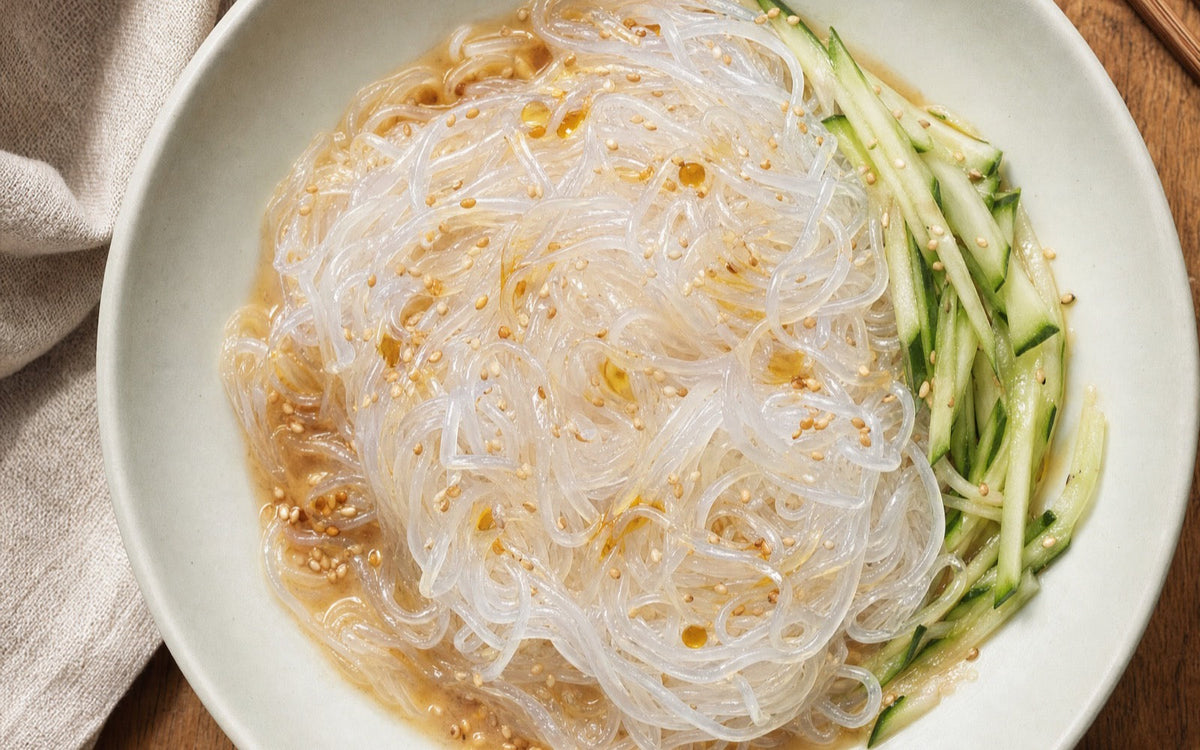
Translucent, springy and almost weightless on the fork, shirataki noodles look like they must be made of something complicated. The ingredient list is shorter than you'd expect.
Shirataki noodles are made of water and konjac flour, the dried, ground root of the konjac plant, and that is essentially the whole recipe. Ours list three ingredients, water, konjac flour and citric acid, and come to 5 calories per 3-ounce serving, because the noodle is mostly water held inside a soluble fiber called glucomannan.
I first ate them in 2006 at a Buddhist-run vegetarian restaurant outside Kyoto, and I remember being amazed that something so satisfying could be so light. The explanation turned out to be wonderfully simple. Let me take the ingredients one at a time.
What are shirataki noodles made of?
Konjac flour. This is the heart of the noodle. It comes from the corm, the round underground stem, of a plant called Amorphophallus konjac, which grows in China, Japan and Southeast Asia. The corm is dried and milled into a fine powder that's made mostly of glucomannan, a soluble fiber. I wrote a full piece on it: What is konjac flour?
Water. Most of the noodle is water. A small amount of konjac flour mixed into a large amount of water swells and sets into a firm, springy gel, and that gel is cut into strands. Our konjac rice, made the same way in a different shape, is about 97 percent water and 3 percent konjac flour.
Citric acid. This one is in the packing water, not in the noodle. It keeps the pouch fresh on the shelf without refrigeration, and a rinse under cold water takes it away.
That's it. No wheat, no egg, no starch. Which is why they're plant-based and gluten-free.

What does "shirataki" mean?
In Japanese, shirataki means "white waterfall," which is a lovely description of a tangle of these pale, translucent strands. The firmer blocks made from the same konjac gel are called konnyaku. Japan, China and much of Southeast Asia have been eating konjac in one form or another for a very long time.
Are shirataki noodles the same as konjac noodles or yam noodles?
Shirataki noodles and konjac noodles are the same thing: "shirataki" is the Japanese name, and "konjac" names the plant they're made from. You'll also see them called glucomannan noodles, after the fiber, or konjac root noodles.
"Yam noodles" is a looser name. The konjac plant is sometimes called the konjac yam, but it isn't related to the sweet potatoes and yams in your grocery store. It's a different plant entirely, and it stores fiber in its root rather than starch. That's the whole difference on the nutrition label.
How many calories are in shirataki noodles?
Ours have 5 calories per 3-ounce serving, with 3 grams of total carbohydrate, 2 grams of fiber, 1 gram of net carbs, no fat, no sodium and no protein. For comparison, the USDA lists about 134 calories and 26 grams of carbohydrate in 3 ounces of cooked regular pasta.
You'll sometimes see shirataki sold as "zero calorie." That's a rounding rule on U.S. labels, which lets anything under 5 calories a serving read as zero. I explain how that works in Are zero-calorie noodles really zero calories?
The label, in plain words
What's in a 3-ounce serving of our konjac noodles
- Ingredients. Water, konjac flour, citric acid (in the packing water).
- Calories. 5.
- Carbohydrate. 3 g total, 2 g fiber, 1 g net.
- Fat, sodium, protein. 0 g, 0 mg, 0 g.
- Free from. Gluten, grain, soy and animal products.
What is glucomannan, and what does it do?
Glucomannan is the fiber that makes up most of konjac flour, and it's the reason shirataki noodles behave the way they do. There are two kinds of fiber worth knowing about. Insoluble fiber is kind of rough; it moves things through you. Soluble fiber is like a gel, and it does something else.
Glucomannan is the soluble kind, and a very water-loving one. It pulls water in and holds it, which is how a pinch of flour can become a whole bowl of noodles. Your body doesn't have the enzymes to break it down into sugar, so it travels on to your large intestine, where it feeds the natural bacteria in your gut. That makes it a prebiotic: food for the bacteria, the step before probiotics. I cover the two kinds of fiber in The two kinds of fiber in your noodles.
Are shirataki noodles healthy?
I think they're a very good base, and I'll tell you exactly why and where they fall short. They give you the ritual of a bowl of noodles while what's on your fork is mostly water and soluble fiber instead of starch. They're gluten-free, grain-free and plant-based, and the fiber is food for your gut bacteria. When those organisms are happy, everything tends to run a little smoother.
Where they fall short is protein. A shirataki noodle has essentially none, so make sure the rest of the bowl brings it: fish, chicken, tofu, eggs, beans. Add vegetables and a sauce you love, and you have a real meal. If you're new to fiber, start with a smaller portion and drink water with it.
If you'd like the protein built into the noodle itself, that's what our egg white noodles are for: 10 grams of protein, 45 calories and under 1 gram of carbs per bag. Different food, different job.
Questions I get about shirataki noodles
Do you have to cook shirataki noodles?
No. They're ready to eat. Rinse, drain, and add them to your pan with your sauce, vegetables or broth so they warm through and pick up the flavor.
Do shirataki noodles have carbs?
A little. Ours have 3 grams of total carbohydrate per serving, 2 of them fiber, which leaves 1 gram of net carbs.
Are shirataki noodles vegan and gluten-free?
Ours are. They're made from water and a root, with no wheat, egg or dairy.
Why do shirataki noodles need rinsing?
They're packed in water with a little citric acid to keep them fresh. Rinsing under cold water clears it, so all you taste is your sauce.
The takeaway
Shirataki noodles are made of water and konjac flour, with a little citric acid in the packing water. The flour is mostly glucomannan, a soluble fiber that holds a lot of water and isn't turned into sugar, which is why a 3-ounce serving has 5 calories and 1 gram of net carbs. Rinse them, cook them in your sauce, and add a protein to make it a meal.
Konjac Spaghetti
Water, konjac flour and nothing you'd have to look up: 5 calories and 1 gram of net carbs a serving, ready to eat. Shop konjac spaghetti, or see all our shirataki noodles.
Keep reading

Build Your Bundle
Pick your packs across the whole line — konjac, egg white, or a mix of both. One box, one delivery, and you decide exactly what is in it.
References
- Chua M, Baldwin TC, Hocking TJ, Chan K. Traditional uses and potential health benefits of Amorphophallus konjac K. Koch ex N.E.Br. Journal of Ethnopharmacology. 2010. PubMed
- Devaraj RD, Reddy CK, Xu B. Health-promoting effects of konjac glucomannan and its practical applications: a critical review. International Journal of Biological Macromolecules. 2019. PubMed
- U.S. Department of Agriculture, FoodData Central. Pasta, cooked, enriched, without added salt (FDC 169737). FoodData Central
- U.S. Food and Drug Administration. Nutrition labeling of food, 21 CFR 101.9(c)(1). eCFR

Jonathan Carp, MD
A board-certified physician who started Miracle Noodle in 2006 for his own patients. He doesn’t want to sell you something — he wants to help you become your own authority in your health.