Learn / Konjac Basics
Konjac BasicsWhat Is Konjac Flour?
 Jonathan Carp, MD·October 2026·~8 min read
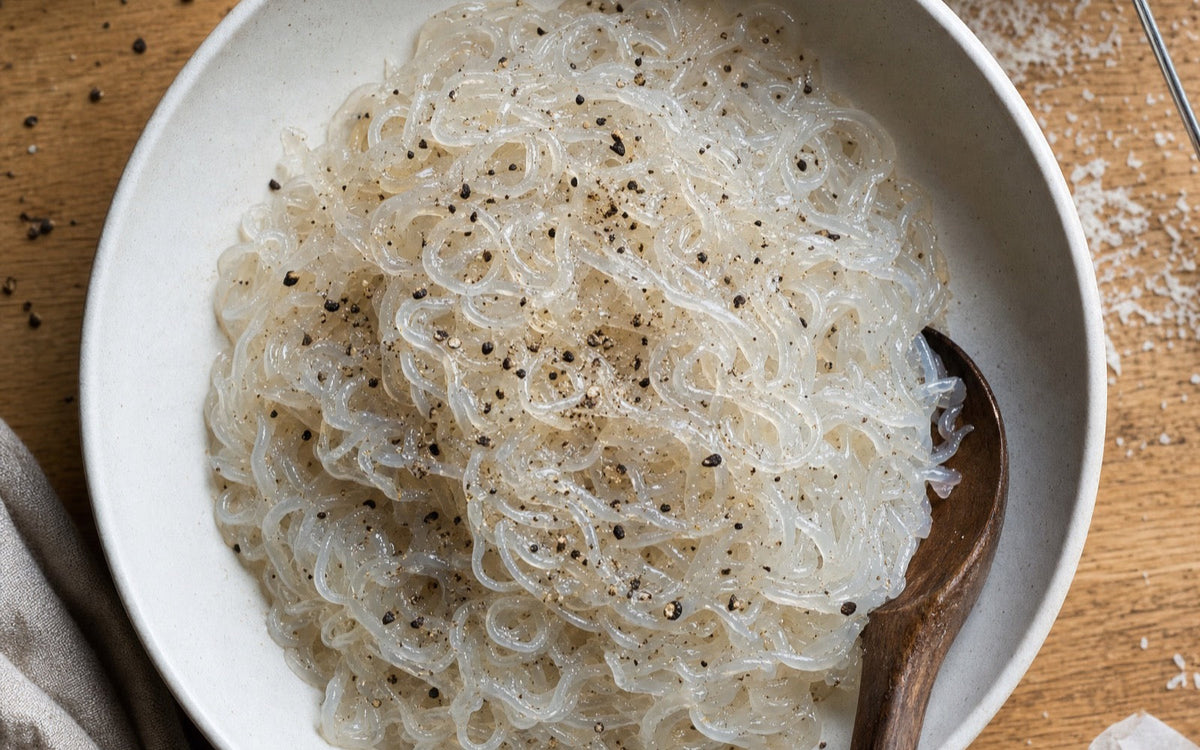
Every konjac noodle starts as a plain, pale powder ground from a root. Here is what that powder is, why it behaves nothing like wheat flour, and how it turns into a bowl of noodles.
Konjac flour is the dried, ground corm of the konjac plant, and it is made mostly of a soluble fiber called glucomannan. Because it is fiber rather than starch, it doesn't break down into sugar the way wheat flour does. It soaks up water and sets into a gel instead, and that gel is how shirataki noodles and konjac rice are made.
People find this confusing, and I understand why. We're used to thinking of flour as one thing. Wheat flour, rice flour, corn flour: all of them are mostly starch. Konjac flour shares the name and almost nothing else. Once you see the difference, the whole category of konjac foods makes a lot more sense.
What is konjac flour made from?
Konjac flour comes from one plant, Amorphophallus konjac, which grows in the hills of China, Japan and Southeast Asia. The part we use is the corm, a round underground stem that looks a bit like a large, rough potato. The plant stores its energy there, and what it stores is glucomannan.
To make the flour, the corm is cleaned, sliced, dried and milled into a fine powder. Nothing is added. It's the root, dried and ground. People across East and Southeast Asia have eaten konjac this way for a very long time, as noodles, firm blocks and snacks, and in China its use goes back more than two thousand years.
If you want the story of the plant itself, I wrote about it in What konjac is. Here I want to stay with the powder, because the powder is what ends up in your bowl.
Is konjac flour the same as glucomannan?
Close, but not quite. Konjac flour is the whole dried root, ground up. Glucomannan is the fiber inside it, and it makes up most of the flour. When the flour is refined further to concentrate that fiber, you get what's sold as konjac glucomannan, or KGM, which shows up as a food thickener and in fiber supplements.
So there are two buckets. Konjac flour is the everyday ingredient, the one that goes into noodles and rice. Purified glucomannan is the concentrated fiber, closer to an extract. "Konjac powder" is usually just another name for konjac flour, though some sellers use it for the purified version, so read the label if it matters for a recipe.
I have a short note that goes deeper on the fiber itself: Meet glucomannan.
How is konjac flour different from wheat flour?
This is the part that explains the nutrition label. Wheat flour is mostly starch, and starch is basically a chain of glucose molecules, almost like a real chain. Your digestive enzymes cut that chain apart, and the glucose goes into your blood. That's why a big bowl of regular pasta raises your blood sugar.
Glucomannan is a different kind of chain. Your body doesn't have the enzymes to cut it apart for energy, so it isn't turned into sugar. It travels on as fiber, and it's a soluble fiber, the kind that behaves like a gel rather than something rough. When it reaches your large intestine, the natural bacteria in your gut can feed on it. That's what makes it a prebiotic. You may have heard of probiotics, which are the bacteria themselves. This is the step before that: the food they live on.
Here's the picture I use. Wheat flour is like dry kindling, because put a match to it and it burns fast. Konjac flour is like a sponge, because it doesn't burn, it soaks. It takes up a large amount of water and holds it in a soft gel, and that's why a food made from it ends up mostly water held in fiber.
At a glance
Konjac flour vs. wheat flour
- Where it comes from. Konjac flour is the dried corm of the konjac plant. Wheat flour is a ground grain.
- What it's mostly made of. Konjac is mostly glucomannan, a soluble fiber. Wheat is mostly starch.
- What your body does with it. Konjac fiber isn't turned into sugar; it feeds the natural bacteria in your gut. Starch is broken down into glucose.
- What it does with water. Konjac swells into a gel. Wheat flour forms a dough.
- Gluten. Konjac has none. Wheat does.
How does konjac flour become noodles?
You take a small amount of konjac flour, mix it with a large amount of water, and let the fiber do what it does: swell and set into a firm, springy gel. That gel is shaped into strands for noodles or small grains for rice, then packed in water so it keeps on the shelf.
That's why the ingredient list on our konjac noodles is so short: water, konjac flour and citric acid. The citric acid is in the packing water, not in the noodle, and rinsing under cold water takes it away. Our konjac rice, for example, is about 97 percent water and 3 percent konjac flour.
That ratio is the whole reason the label reads the way it does. A 3-ounce serving of our konjac noodles has 5 calories and 3 grams of total carbohydrate, 2 of them fiber, which leaves 1 gram of net carbs. For comparison, the USDA lists about 134 calories and 26 grams of carbohydrate in the same 3 ounces of cooked regular pasta. Same fork, very different food.
Can you cook with konjac flour at home?
You can, and it's a fun ingredient once you understand it. Because it gels so strongly, a little goes a long way. Most home cooks use it as a thickener for sauces, soups, gravies and puddings, where they'd otherwise reach for cornstarch.
A few things I'd tell you in the kitchen:
- Use less than you think. Start with a pinch and add more only if you need it, because it keeps thickening as it sits.
- Whisk it into liquid. Sprinkle it slowly into cool liquid while you whisk so it doesn't clump, then heat it.
- Never eat it dry. The powder is meant to be mixed into liquid. Don't take it by the spoonful, because it starts to swell the moment it meets water.
Making your own noodles from scratch is possible, but it's a project. Most people find it easier to keep ready-to-eat konjac noodles in the pantry and use the flour for thickening.
Is konjac flour good for you?
I think of it as a very good ingredient for a specific job. It lets you keep the ritual of a bowl of noodles or rice while most of what's on your fork is soluble fiber and water instead of starch. A meal built that way tends to sit easy, and the fiber gives your gut bacteria something to work with. When those organisms are well fed and happy, everything downstream tends to run a little smoother.
Konjac flour is also naturally gluten-free and grain-free, which makes it a simple swap when wheat is off the table. What it isn't is a source of protein. A konjac noodle carries essentially none, so build the rest of the plate around it with vegetables, a good protein and a sauce you love. And if you're not used to much fiber, add it gradually and drink water with it.
That's the honest answer. Konjac flour isn't magic. It's a root that happens to be almost all fiber, and that's the reason why it behaves the way it does.
Questions I get about konjac flour
Is konjac flour gluten-free?
Yes. Konjac is a root, not a grain, so it contains no gluten. Our konjac noodles and rice are gluten-free.
Does konjac flour have carbs?
Technically yes, because fiber is counted as carbohydrate on a nutrition label. But most of konjac's carbohydrate is fiber. That's why a serving of our konjac noodles shows 3 grams of total carbohydrate, 2 grams of fiber and 1 gram of net carbs.
Is konjac flour the same as konjac powder?
Usually. Both names describe the dried, ground root. Some products labeled "konjac powder" are purified glucomannan, so check the label if you're following a recipe.
What does konjac flour taste like?
Almost nothing. Konjac fiber has essentially no flavor of its own, which is why konjac noodles take on whatever sauce you cook them in.
Can I swap konjac flour for wheat flour in baking?
Not one for one. It gels instead of forming a dough, so in baking it's used in small amounts as a binder alongside other flours.
The takeaway
Konjac flour is the dried, ground root of the konjac plant, and it's mostly glucomannan, a soluble fiber. It doesn't break down into sugar the way wheat flour does; it soaks up water and sets into a gel. Mix a little of it with a lot of water and you get shirataki noodles and konjac rice, with 5 calories and 1 gram of net carbs per serving and a fiber that feeds the natural bacteria in your gut.
Konjac flour, ready to eat
If you'd rather not make noodles from scratch, ours are water and konjac flour, with a little citric acid in the packing water. Rinse, drain, and add them to whatever you're cooking. See the konjac noodles, or start with konjac rice.
Keep reading

Build Your Bundle
Pick your packs across the whole line — konjac, egg white, or a mix of both. One box, one delivery, and you decide exactly what is in it.
References
- Chua M, Baldwin TC, Hocking TJ, Chan K. Traditional uses and potential health benefits of Amorphophallus konjac K. Koch ex N.E.Br. Journal of Ethnopharmacology. 2010. PubMed
- Devaraj RD, Reddy CK, Xu B. Health-promoting effects of konjac glucomannan and its practical applications: a critical review. International Journal of Biological Macromolecules. 2019. PubMed
- U.S. Department of Agriculture, FoodData Central. Pasta, cooked, enriched, without added salt (FDC 169737). FoodData Central

Jonathan Carp, MD
A board-certified physician who started Miracle Noodle in 2006 for his own patients. He doesn’t want to sell you something — he wants to help you become your own authority in your health.