Learn / Konjac Basics
Konjac BasicsWhat Is Shirataki Rice?
 Jonathan Carp, MD·October 2026·~6 min read
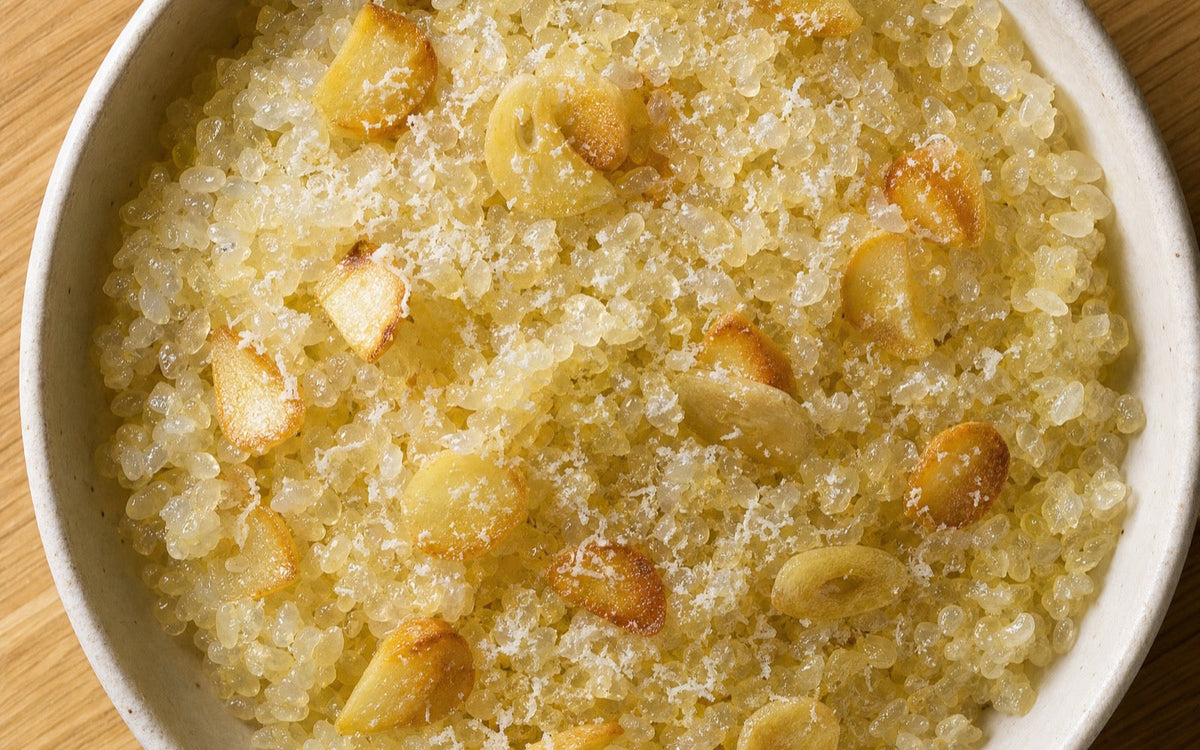
Rice was the food people told me they missed most. Shirataki rice is the answer I kept coming back to: something you can spoon a curry over, made from a root instead of a grain.
Shirataki rice is konjac shaped like rice: small grains made from water and konjac flour, the dried, ground root of the konjac plant. Because it's fiber rather than grain, a 3-ounce serving of ours has 5 calories and 1 gram of net carbs, compared with about 110 calories and 24 grams of carbohydrate in the same amount of cooked white rice.
It's the same ingredient as shirataki noodles, just cut into a different shape. If you know one, you already know most of the other. What changes is how you use it, and that's where a few small habits make a big difference.
What is shirataki rice made of?
Ours lists three ingredients: water, konjac flour and citric acid. The citric acid is in the water the rice is packed in, not in the rice itself, and it's there to keep the pouch fresh on the shelf. A rinse takes it away.
Konjac flour is the interesting part. It comes from the corm, the underground stem, of a plant called Amorphophallus konjac, and it's made mostly of a soluble fiber called glucomannan. When you mix a little of that flour with a lot of water, the fiber swells and sets into a firm gel. Shape that gel into small grains and you have shirataki rice. Ours is about 97 percent water and 3 percent konjac flour.
I go deeper on the flour itself in What is konjac flour?
How many carbs and calories are in shirataki rice?
Per 3-ounce (85 g) serving, our konjac rice has 5 calories, 3 grams of total carbohydrate, 2 grams of fiber and 1 gram of net carbs, with no fat, no sodium and no protein. Here it is next to cooked white rice from the USDA's FoodData Central database:
| Per 3 oz (85 g) | Shirataki rice (ours) | White rice, cooked (USDA) |
|---|---|---|
| Calories | 5 | about 110 |
| Total carbohydrate | 3 g | about 24 g |
| Fiber | 2 g | under 1 g |
| Protein | 0 g | about 2 g |
The reason is simple. White rice is mostly starch, and starch is a chain of glucose molecules your enzymes cut apart, so the glucose goes into your blood. Glucomannan is a chain your body can't cut apart for energy. It isn't turned into sugar; it travels on as fiber and feeds the natural bacteria in your gut. They look alike in the bowl and behave nothing alike once they're inside you.
What does shirataki rice taste like?
On its own, almost nothing. Konjac fiber has essentially no flavor, which sounds like a drawback and is actually the point, because it takes on whatever you cook it with. Put it under a curry, toss it through a stir-fry or let it sit in a soup, and it tastes like the dish.
The texture is its own thing, and I'd rather tell you that up front. It isn't fluffy like jasmine rice. It's tender with a slight spring, closer to a small, soft grain than a dry one. Most people like it best in dishes with a sauce or broth, where that texture feels right at home.
How do you cook shirataki rice?
It's ready to eat, so you aren't really cooking it so much as warming it into a dish. Three steps:
- Rinse. Pour it into a fine strainer and rinse under cold water. This clears the packing water.
- Drain well. Shake the strainer and let it drip. The less water you bring to the pan, the better it takes on flavor.
- Cook it in the dish. Add it to your pan with your vegetables, protein, sauce or broth and let everything cook together.
If you want a firmer, more separate grain for fried rice, give the drained rice a short time in a dry, hot pan before anything else goes in. You'll see the surface go from glossy to dry as the extra water steams off. A grain that's already full of water can't take in much else, and a slightly drier one soaks up the sauce. Then add your oil and the rest of your ingredients.
For more, see How to prepare Miracle Noodles.
Where it works best
Five places to use shirataki rice this week
- Under a curry or stew, where the sauce does the talking.
- Fried rice, after a short dry-pan step.
- Soups and congee-style bowls, where its spring feels natural.
- Burrito bowls, with beans, salsa and avocado.
- Half and half with regular rice, if you're easing in.
Can you mix shirataki rice with regular rice?
Yes, and it's one of the easiest ways to start. Stir a pouch of shirataki rice into a smaller portion of cooked rice and you keep the familiar taste while the bowl stays light. You get the volume of a full bowl with a fraction of the starch.
I like this approach because it isn't about giving anything up. It's about adding something to the bowl that lets the rest of the plate shine.
Is shirataki rice healthy?
It's a clean, simple base, and it does one thing very well: it gives you a full bowl that's mostly soluble fiber and water instead of starch. That fiber is a prebiotic, which means it's food for the natural bacteria in your gut, and a well-fed gut is a happy one.
It isn't a complete meal by itself, because there's no protein in it. Build the bowl the way you would any good meal: a protein you enjoy, plenty of vegetables, a little fat for flavor. And if you're new to fiber, start with a smaller portion and drink water with it.
Questions I get about shirataki rice
Is shirataki rice the same as konjac rice or Miracle Rice?
Yes. Shirataki rice, konjac rice and Miracle Rice all describe rice-shaped konjac. Miracle Rice is the name we've used for years for our konjac rice.
Is shirataki rice gluten-free?
Yes. It's made from a root, not a grain, so there's no gluten in it.
Can you freeze shirataki rice?
No. Our label says do not freeze, because freezing changes the texture of the gel. Keep the sealed pouches in the pantry.
Do you need to boil shirataki rice?
No. It comes fully prepared and ready to eat. Rinse, drain, and warm it in whatever you're cooking.
The takeaway
Shirataki rice is konjac fiber and water shaped into small grains. It isn't a grain, so a 3-ounce serving has 5 calories and 1 gram of net carbs, against roughly 110 calories and 24 grams of carbohydrate for cooked white rice. Rinse it, drain it well, and cook it into a dish with a sauce or broth, and it takes on every bit of flavor you give it.
Konjac Rice
Grain-free rice made from konjac fiber instead of starch: 5 calories and 1 gram of net carbs a serving, ready to eat. Use it anywhere rice goes. Shop konjac rice
Keep reading

Build Your Bundle
Pick your packs across the whole line — konjac, egg white, or a mix of both. One box, one delivery, and you decide exactly what is in it.
References
- U.S. Department of Agriculture, FoodData Central. Rice, white, long-grain, regular, enriched, cooked (FDC 168878). FoodData Central
- Chua M, Baldwin TC, Hocking TJ, Chan K. Traditional uses and potential health benefits of Amorphophallus konjac K. Koch ex N.E.Br. Journal of Ethnopharmacology. 2010. PubMed
- Behera SS, Ray RC. Konjac glucomannan, a promising polysaccharide of Amorphophallus konjac K. Koch in health care. International Journal of Biological Macromolecules. 2016. PubMed

Jonathan Carp, MD
A board-certified physician who started Miracle Noodle in 2006 for his own patients. He doesn’t want to sell you something — he wants to help you become your own authority in your health.