Learn / Konjac Basics
Konjac BasicsAre Zero-Calorie Noodles Really Zero Calories?
 Jonathan Carp, MD·October 2026·~7 min read
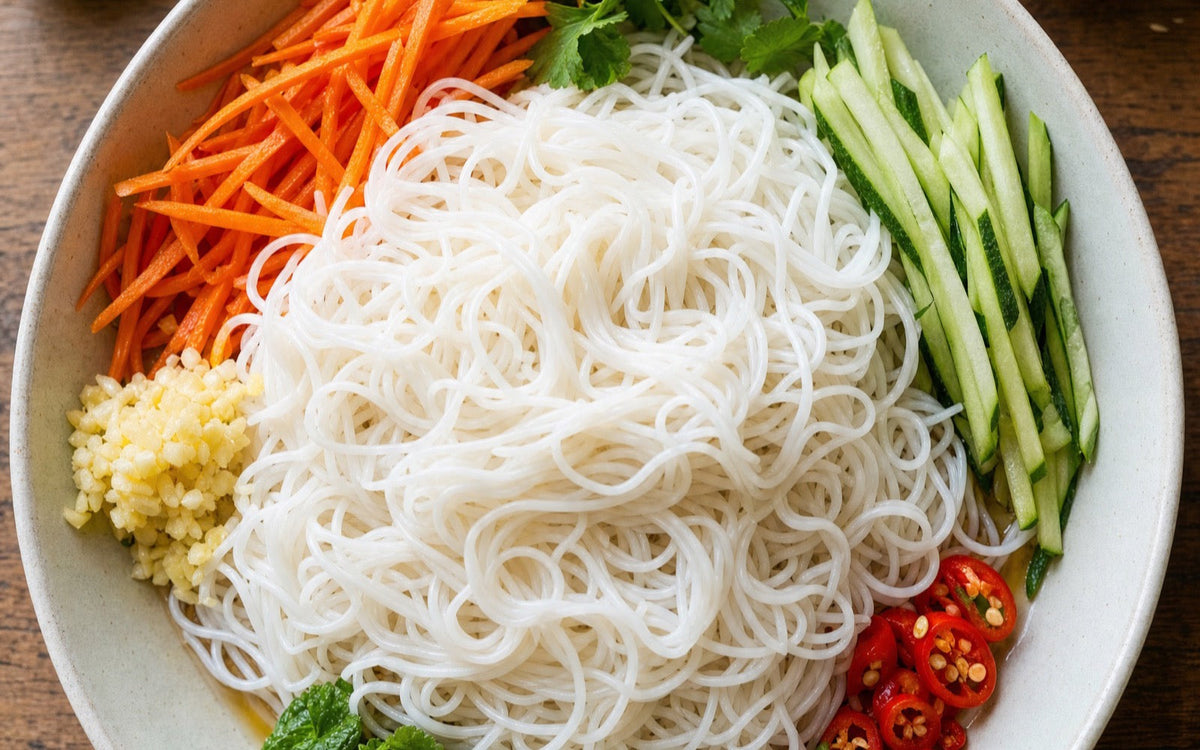
The label can say zero. Your body still knows the difference between almost nothing and nothing at all. Here's what is actually in the bag, and why the number is so low.
Zero-calorie noodles aren't quite zero. They're almost always konjac noodles, also called shirataki, and a serving usually carries somewhere around 5 to 10 calories, because U.S. labeling rules let any food with fewer than 5 calories per serving list its calories as zero.
That isn't a trick, and it doesn't make these noodles any less useful. It just helps to know what you're reading. Once you understand where the few calories come from, you'll also understand why these noodles behave the way they do on your plate and in your body.
Do zero-calorie noodles really have zero calories?
Not literally. Almost every noodle sold as "zero calorie" is made from konjac flour and water, and konjac flour is mostly a soluble fiber called glucomannan. Fiber still counts for a little energy, so the honest number is small but not nothing.
Our own label says it plainly: 5 calories per 3-ounce serving of konjac noodles. Other brands print 0, 5 or 10. The difference usually comes down to two things, the serving size they chose and how the number gets rounded.
Why can a noodle label say 0 calories?
Because of a federal rounding rule. On a U.S. Nutrition Facts panel, calories are rounded to the nearest 5 up to 50 calories, and any amount under 5 calories per serving may be shown as zero. So a food with 4 calories a serving can legally say 0.
Serving size moves the number too. Make the serving a little smaller and you can push it under 5. That's why I'd tell you to read two lines on any "zero" product: the serving size, and the total carbohydrate. If there are grams of carbohydrate on the label, there are a few calories in the food.
The same rule exists for carbohydrate, by the way. Under half a gram per serving may be listed as zero. I wrote more about that in Are there noodles with no carbs?
What are zero-calorie noodles made of?
Konjac flour and a lot of water. Konjac flour is the dried, ground root of the konjac plant, and when you mix a little of it with a lot of water, the fiber swells and sets into a firm gel. That gel is shaped into noodles. Ours list three ingredients: water, konjac flour and citric acid, which sits in the packing water to keep the noodles fresh and rinses away.
So a konjac noodle is mostly water held inside fiber. That's the entire secret of the low number. If you want the full story of the powder, read What is konjac flour?
Why does fiber count for so few calories?
There are two kinds of carbohydrate in this story. Starch, the main thing in wheat pasta, is broken down by your digestive enzymes into glucose, and your body uses all of it. That's why the label counts it at 4 calories a gram.
Soluble fiber is different. Your own enzymes can't break it down, so it travels on to your large intestine, where the natural bacteria in your gut ferment it. They use most of it themselves, and the short-chain fatty acids they make hand a little energy back to you. That's why federal labeling rules count soluble fiber at about 2 calories a gram instead of 4.
Think of starch as cash you spend right away. Soluble fiber is more like a gift card for the bacteria in your gut. They spend most of it, and you get a little change back.
How do 5-calorie noodles compare with regular pasta?
Here's the same 3 ounces of each, side by side. The pasta and egg noodle figures come from the USDA's FoodData Central database; the konjac and egg white figures come from our own labels.
| Noodle | Serving | Calories | Total carbs | Protein |
|---|---|---|---|---|
| Konjac noodles (ours) | 3 oz (85 g) | 5 | 3 g (2 g fiber) | 0 g |
| Regular pasta, cooked (USDA) | 3 oz (85 g) | about 134 | about 26 g | about 5 g |
| Egg noodles, cooked (USDA) | 3 oz (85 g) | about 117 | about 21 g | about 4 g |
| Egg white noodles (ours) | 1 bag (100 g) | 45 | under 1 g | 10 g |
The gap is real, and it's why so many people keep konjac noodles in the pantry. You get the bowl, the twirl and the sauce, and most of the calories on the plate come from what you put with it.
Reading a "zero" label
Three things worth checking
- Serving size. A smaller serving can round the calories down to zero.
- Total carbohydrate. If there are grams here, there are a few calories in the food.
- Ingredients. The best ones are short: water and konjac flour, and little else.
Will zero-calorie noodles keep me full?
They help, but they can't do it alone, and I want to be straight with you about that. Konjac noodles give you volume, and soluble fiber forms a gel that moves through slowly, so a bowl feels like a real meal. The fiber also feeds the bacteria in your gut, and what those bacteria produce supports your body's own fullness signals. I explain that part in How fiber supports your own fullness signals.
What konjac doesn't have is protein. A bowl that's only konjac and a light sauce can leave you looking for a snack an hour later. So treat the noodle as the base and build on it: a good protein, plenty of vegetables, a little fat for flavor. That's a plate that actually holds you.
When would I choose egg white noodles instead?
When the meal needs protein. Egg white noodles aren't zero calorie, and they aren't trying to be. A bag has 45 calories, 10 grams of protein and under 1 gram of carbohydrate, and the label is egg white, water and a touch of algae extract.
So here are the two buckets. Konjac is fiber, the lightest possible base. Egg white is protein, a base that carries some weight. Most people end up keeping both, and reaching for whichever one the rest of the plate needs.
Questions I get about zero-calorie noodles
Are zero-calorie noodles healthy?
They're a simple, clean base. The good ones are just water and konjac fiber, which is plant-based, gluten-free and food for the natural bacteria in your gut. What makes the meal healthy is what you build around them.
Do zero-calorie noodles have carbs?
A little. Ours have 3 grams of total carbohydrate per serving, and 2 of those grams are fiber, which leaves 1 gram of net carbs.
Why do you rinse them?
Konjac noodles are packed in water with a little citric acid to keep them fresh. Rinse them under cold water and drain, and the acid goes with the water.
Do you have to cook them?
No. They're ready to eat. Rinse, drain, and add them to your pan with your sauce, vegetables or broth so they warm through and take on the flavor.
The takeaway
Zero-calorie noodles are konjac noodles, and they carry a few calories, not none. U.S. labels can round anything under 5 calories a serving down to zero. The number stays low for an honest reason: the noodle is mostly water held in soluble fiber, which your body barely draws energy from. Use them as a base, add protein and vegetables, and you have a bowl that feels like dinner.
5 calories, honestly labeled
Our konjac spaghetti, fettuccine and angel hair carry 5 calories and 1 gram of net carbs per serving, and our label says so. See the konjac noodles, or try konjac spaghetti first.
Keep reading

Build Your Bundle
Pick your packs across the whole line — konjac, egg white, or a mix of both. One box, one delivery, and you decide exactly what is in it.
References
- U.S. Food and Drug Administration. Nutrition labeling of food, 21 CFR 101.9(c)(1). eCFR
- U.S. Department of Agriculture, FoodData Central. Pasta, cooked, enriched, without added salt (FDC 169737). FoodData Central
- U.S. Department of Agriculture, FoodData Central. Noodles, egg, enriched, cooked (FDC 169732). FoodData Central
- Devaraj RD, Reddy CK, Xu B. Health-promoting effects of konjac glucomannan and its practical applications: a critical review. International Journal of Biological Macromolecules. 2019. PubMed

Jonathan Carp, MD
A board-certified physician who started Miracle Noodle in 2006 for his own patients. He doesn’t want to sell you something — he wants to help you become your own authority in your health.