Learn / GLP-1
GLP-1How to increase GLP-1 naturally: the doorbell in your gut
 Jonathan Carp, MD·October 2026·~10 min read
Your body was already making GLP-1. Here's what blocks that signal, and the everyday choices that help it ring again.
You can increase GLP-1 naturally because your body already knows how to make it. GLP-1 is released by cells in your gut every time you eat, and it works basically like a text message to your brain and the rest of your body: food is here, you can stand down. For a lot of people, the system isn't broken. The modern food environment just keeps the message from being sent. This piece is for anyone who wants to support their body's own fullness signaling, whether or not a GLP-1 medication is part of their life.
The doorbell in your gut
Here's the picture I use. Lining your intestine, mostly further down in a section called the ileum, are specialized cells called L-cells. Think of each one as a front door with a doorbell. When the right kind of food comes down the hall, it knocks loudly, the bell rings, and the L-cell sends GLP-1 out as a message. To your brain, it says, I've got food; you don't need to eat anymore. Your pancreas and the rest of your body hear it at the same time.
Some foods knock loudly on that door. Some walk right by it.
There are really two bells in this story. One is the pleasure bell, the dopamine rush from something sweet or salty and crunchy. The other is the satiety bell, the one that says you've had enough. A lot of modern food rings the first bell loudly and never touches the second. And when the satiety bell doesn't ring, you're going to keep eating. We don't even have to talk about willpower here. You simply aren't getting the message.
Foods that walk right past the door
Liquid sugar. Soft drinks, juice, sweetened coffee. These arrive too fast for the L-cells to respond, so the calories get mainlined into your bloodstream without sending the signal. Your brain registers taste and pleasure, but not food. It's an imperfect analogy, but that's closer to how a drug behaves than a meal.
Refined carbohydrates. White bread, crackers, most cereals. A refined carbohydrate is essentially sugar molecules linked in a chain, and with no fiber to carry it along, it's absorbed high up in the gut before it reaches the L-cells further down.
Artificial sweeteners. They ring the taste receptors in your mouth but deliver nothing to the gut. Your intestines are expecting something to arrive, and nothing does.
Low-fat processed foods. I started a food company, so I say this with some humility: the food industry bought the low-fat message hook, line, and sinker in the '80s and '90s. Fat is one of the main triggers for GLP-1. Take it out, replace it with sugar and thickeners, and you've basically disconnected the doorbell.
Emulsifiers. These additives force oil and water to mix. Research, much of it still in animals, suggests some of them can disturb the gut barrier, which is exactly where those L-cells live.
Foods that knock loudly: how to increase GLP-1 naturally at the table
Protein rings the bell louder than any other food. One amino acid in particular, leucine, fits the lock like a well-cut key. Leucine is concentrated in eggs, fish, whey, and Greek yogurt. Beans carry less, but they still help.
There's an idea called the protein leverage hypothesis: you'll keep eating until you've gotten a certain amount of protein. In a study I share often, researchers served lean adults menus designed to look and taste alike, with the protein quietly changed. When protein dropped from 15% to 10% of calories, people ate about 12% more total energy, much of it from savory snacks between meals (Gosby et al., 2011). Raising protein to 25% didn't lower intake further. So the lesson isn't that more is always better. It's don't fall short.
Good fats slow digestion down, which gives the L-cells more time with your food. Olive oil, avocado, salmon, walnuts.
Fermented foods are, in a sense, pre-digested. Fermentation breaks protein into small fragments that ring the bell faster and through more pathways, and it often feeds your gut bacteria along the way. Kefir is the best studied. Plain yogurt, kimchi, tempeh, and aged cheese count too. I'm a big fan of natto, fermented soybeans I came to love in Japan, though it's an acquired taste.
Umami foods were the revelation of this class for me. Umami is the savory fifth taste: aged Parmesan, anchovies, tomato paste, miso, dried shiitake, and dashi, the Japanese broth made with kombu. I'd always felt that savory meals were more satisfying and assumed it was psychological. Preparing this class, I learned that L-cells carry receptors that sense glutamate, the molecule behind savory flavor. The research is early, but it gave me a physical explanation for something I'd felt for twenty years. I suggest one umami food a day.
Bitter foods like dark chocolate, coffee, and green tea appear to touch receptors that help trigger the release as well.
Fiber works through a second messenger: the natural bacteria in your gut. Think of your gut as garden soil. When the bacteria digest fiber, they release chemicals that knock on the L-cell's door on your behalf. Rich soil sends a strong signal; depleted soil doesn't. I've written about one of those chemicals in propionate and satiety. Aim for variety: oats, garlic, leeks, asparagus, green banana, cooked-and-cooled rice or potatoes, and konjac, which is made from a soluble fiber called glucomannan. More kinds of plants feed more kinds of bacteria.
The order you eat in matters more than you think
Get your protein and vegetables in first and eat your carbohydrates last. Protein and vegetables give the L-cells maximum exposure time, and starch that follows other food arrives more gently. If you're in your 60s or 70s, or you're on a GLP-1 medication, protein comes first, no question.
In a small study of eight healthy young adults whose blood sugar was already in the normal range, eating the same rice, vegetables, and meat with the rice last produced a smaller rise in glucose and insulin after the meal than eating the rice first (Nishino et al., 2018). With eight people, treat it as a clue, not a verdict. But it's the same food in a different order, and it costs nothing to try.
Beyond the plate: muscle, sleep, and stress
Movement. Muscle talks to your gut too. A meta-analysis of single exercise sessions found that a bout of exercise tended to lower ghrelin, the hunger hormone, and raise fullness hormones, with GLP-1 up by a median of about 13% (Schubert et al., 2014). To be honest, the GLP-1 part came from only a handful of studies, and the effect was small. Aim for about 150 minutes a week of aerobic work, and brisk walking counts, plus resistance work two or three times a week. That puts a do-not-demolish sign on your muscle.
Sleep. I teach that a single bad night turns the hunger volume up the next day. You wake up hungrier, and your fullness system responds less to food. A meta-analysis of 41 randomized trials found that people whose sleep was restricted reported more hunger and ate roughly 250 more calories a day (Zhu et al., 2019). Interestingly, it didn't find strong evidence for changes in average leptin or ghrelin levels, so the exact hormonal route is still being worked out. The appetite effect is the consistent part, and no amount of willpower outlasts it.
Stress. Most of us live in what my teacher called the false emergency state: a response designed for a lion attack, set off by a deadline or an elevator that's thirty seconds late. Your body floods the bloodstream with fuel so you can run, puts digestion on hold, and turns off satiety signals, because nobody digests lunch while being chased. The practice he taught me sounds almost silly. Use your own name and ask, "Jonathan, is my life in danger at this moment?" The answer is almost always no, and asking creates a space that softens the reaction.
Your fullness signal keeps time.
Every organ in your body runs on its own clock, and GLP-1 follows one too. The response tends to be larger earlier in the day, which is one reason I don't think skipping breakfast is a good idea for most people. Stop eating two to three hours before bed, and ideally keep a long overnight gap with an early dinner and a normal breakfast. I'm speaking in ideals, so adapt this to your life.
Then set the clock. Get outside first thing in the morning, sunglasses off, ideally for a walk. Morning sunlight tells your whole system it's morning, and believe it or not, that helps you sleep that night. The human body really is a miraculous symphony.
Where I'd start this week
One lever from each part of the day
- Plate order. Protein and vegetables first, carbohydrates last.
- One fermented food. Sauerkraut, kimchi, plain yogurt, or kefir.
- One umami food. A shaving of aged Parmesan or a cup of miso soup.
- Resistance work twice a week. Body-weight exercises are a fine start.
- Protect your sleep. It's the greatest hormone recalibration tool you have.
- One stress-down practice. A walk outside, or asking yourself by name whether your life is really in danger.
- Eat with daylight. Earlier meals, morning light, nothing in the last hours before bed.
Questions I get about this
Do I need to eat three meals a day?
Not really. Three meals is more of a cultural habit. Two can work as long as you're getting enough nutrition, though one meal a day makes it hard to get the protein you need. It does seem worthwhile to eat something in the morning, as a way of telling your system the day has started.
Aren't fermented foods high in salt?
Many are, because salt is part of how vegetables are fermented. Some sauerkrauts are much lower in sodium than others, so read labels. A forkful goes a long way.
Can food replace a GLP-1 medication?
That's not what this is about. The medications keep the signal turned up around the clock, while your own GLP-1 comes in short pulses with meals. Everything here supports your body's own signaling, with or without a medication. Any decision about a prescription belongs with you and your doctor.
The takeaway
You can increase GLP-1 naturally because the doorbell is already there. Food, gut bacteria, movement, sleep, stress, and timing aren't six separate tips. They all restore the same environment, one that lets a message your body was born knowing how to send get through again. Start with protein and vegetables first, then add one lever at a time. Understanding why is how you become your own authority in health.
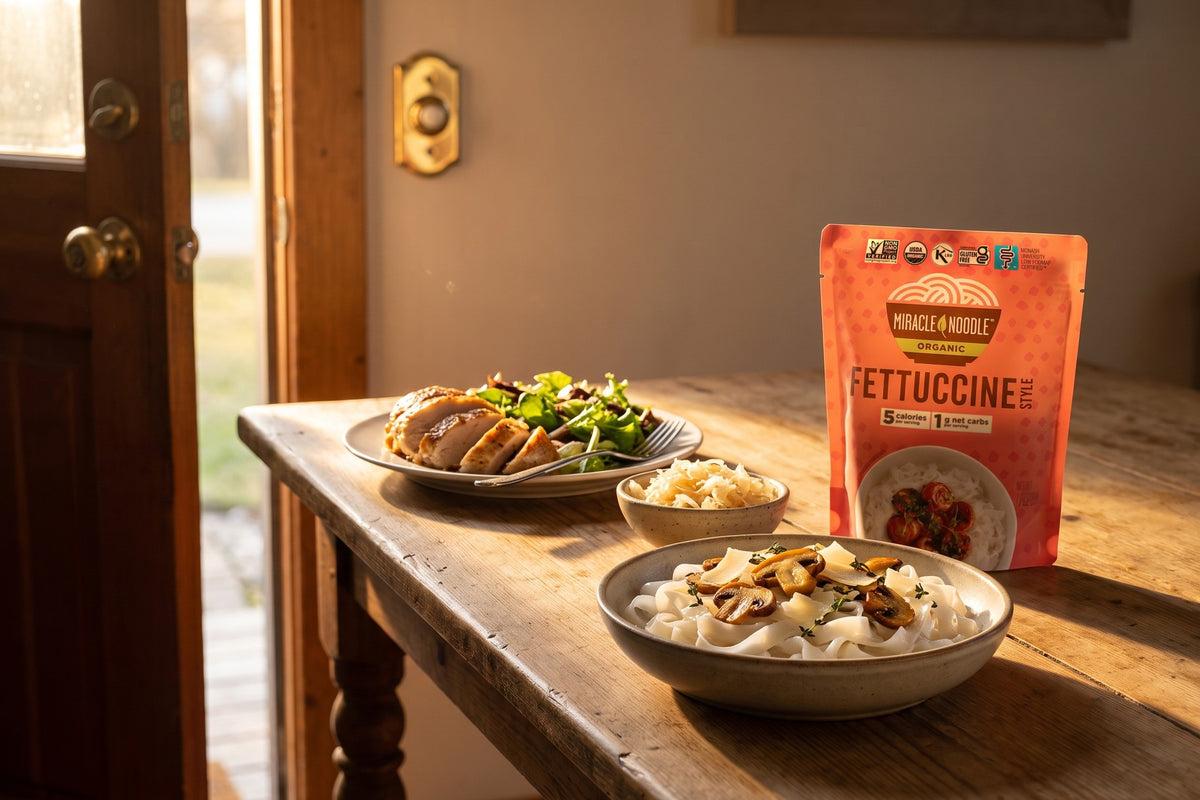
Two of these levers are easy to put on a plate. For protein first, I like egg white noodles: nothing but egg whites, water, and a little algae extract, with 10 grams of protein in 45 calories and 1 gram of net carbs. For fiber, konjac noodles are made from glucomannan, a soluble prebiotic fiber that feeds the natural bacteria in your gut, at 0 to 10 calories. More in-depth on glucomannan.
Keep reading from this class series

Build Your Bundle
Pick your packs across the whole line — konjac, egg white, or a mix of both. One box, one delivery, and you decide exactly what is in it.
References
- Gosby AK, Conigrave AD, Lau NS, et al. Testing protein leverage in lean humans: a randomised controlled experimental study. PLoS One. 2011. PubMed
- Nishino K, Sakurai M, Takeshita Y, Takamura T. Consuming Carbohydrates after Meat or Vegetables Lowers Postprandial Excursions of Glucose and Insulin in Nondiabetic Subjects. J Nutr Sci Vitaminol (Tokyo). 2018. PubMed
- Schubert MM, Sabapathy S, Leveritt M, Desbrow B. Acute exercise and hormones related to appetite regulation: a meta-analysis. Sports Med. 2014. PubMed
- Zhu B, Shi C, Park CG, Zhao X, Reutrakul S. Effects of sleep restriction on metabolism-related parameters in healthy adults: A comprehensive review and meta-analysis of randomized controlled trials. Sleep Med Rev. 2019. PubMed

Jonathan Carp, MD
A board-certified physician who started Miracle Noodle in 2006 for his own patients. He doesn’t want to sell you something — he wants to help you become your own authority in your health.